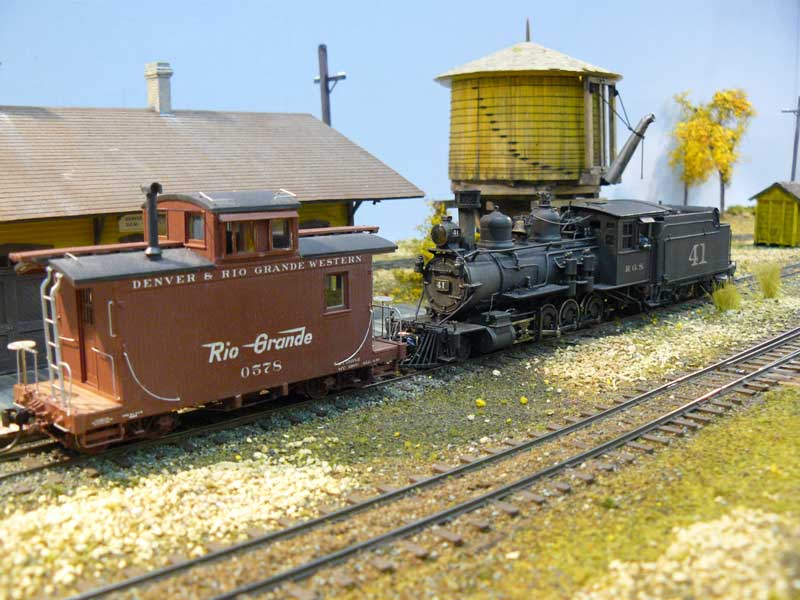
Other features include
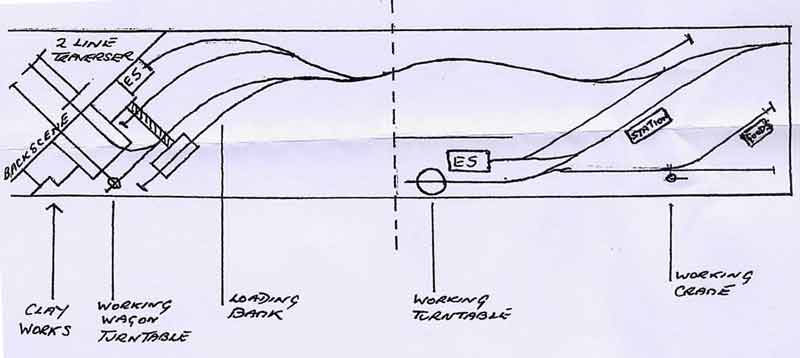
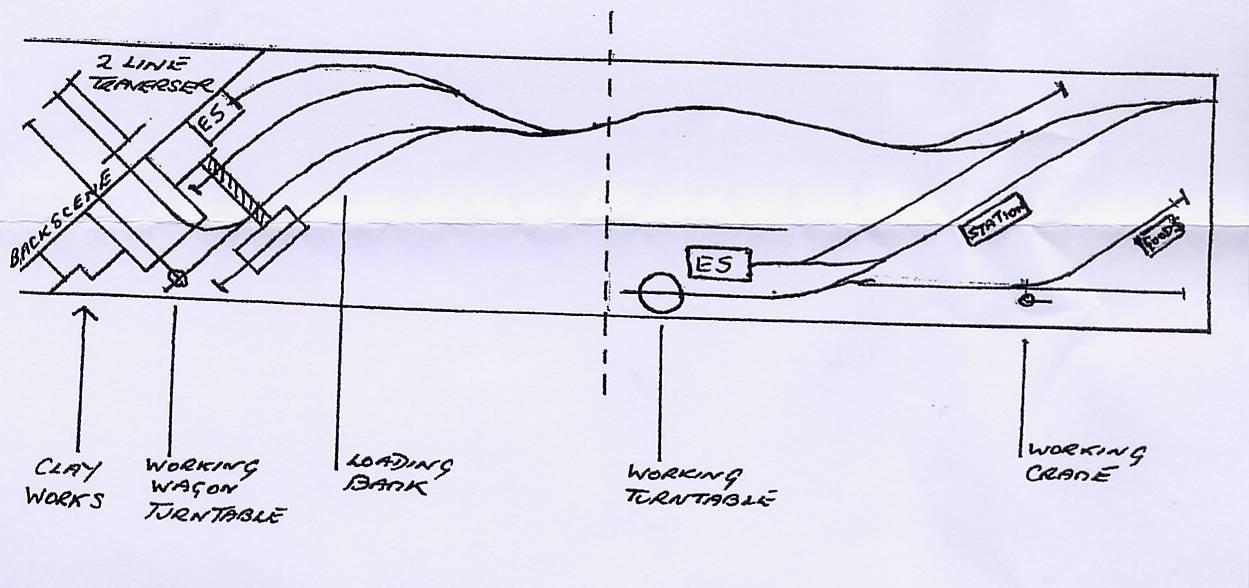
- Working loco turntable.
- Motorized wagon turntable in the clay works.
- Motorized yard crane in the goods yard.
- Motorized drag liner
- Buildings with fitted interiors.
https://www.narrowgaugenorth.org.uk/index.php/85-public-news/exhibitors-previous?start=184#sigProId7c4690ee65
A 009 layout by Stan Williams
Scale 4mm/1ft
Gauge 9mm
Size 10’ x 2’
Rothampton is a fictional place somewhere in the North of England, at the head of a valley. The railway is essentially a farmer’s line bringing in the coal, farm feeds and materials. Sheep, cattle and timber are taken down the valley. Passengers are catered for on the occasional mixed trains, with extra trains on market days down the valley, and at weekends.
The operators are members of the 009 SOCIETY which caters for small scale narrow gauge modellers. We will be happy to answer any questions regarding the society, the layout, scenic’s and the models. In return we ask you to enjoy watching the trains go by and, if present, control your children and prevent any finger poking. Most of the models are made by the operators, and it only takes a second to destroy many hours work.
https://www.narrowgaugenorth.org.uk/index.php/85-public-news/exhibitors-previous?start=184#sigProId79d7d5e545
A HOm layout by Dave Howsam
Scale 3.5mm/1ft
Gauge 12mm
Size 7’ x 3’
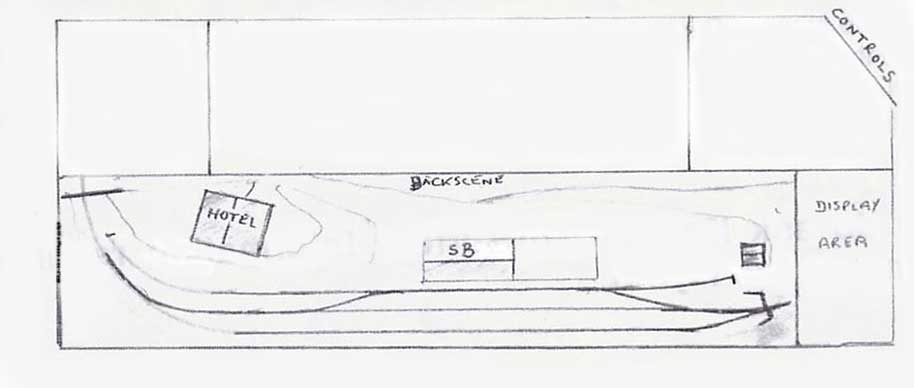
Untermutten is a fictitious location in Switzerland on the Albula line of the Rhätische Bahn from Chur to St Moritz' although Mutten, and in summer Obermutten, is served by post bus from Thusis. The layout was developed as somewhere to run my stock which had been unused for over 10 years since the sale of my previous small HOm effort, Obermutten, and, if required, as a one day exhibition layout.
It was initially made 6'2" long but it was cut down to six foot to fit in the car and allow my wife to come along too! The track originally curved away at both ends -symmetrically, under a bridge and into a tunnel. I found that with this and the loss of the 2 inches I could not quite get a 4 coach train in the station loops. An extra piece was added and the curve moved onto the new board. So much for keeping baseboards, baseboard joints and set up time to a minimum.
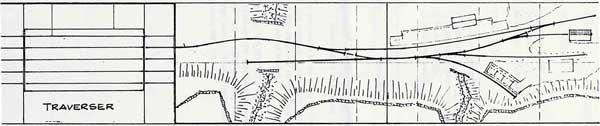
An 8 road traverser, using extending drawer runners, allows for maximum length trains in the storage area. It takes longer to change tracks with a traverser than points but in a given space can give a greater number of trains and longer ones.
Track work is Bemo with their code70 (Shinohara) track in the station & the original track elsewhere. A combination of the Bemo 330mm & 376mm set radius curves is used. Points are powered by Bemo motors using brass strip for linkage. Point lanterns work from the points with a replacement operating wire. Ballasting is carefully carried out using Woodlands Scenics. The station building and hotel (inspired by the Hotel Grischuna at Filisur) are from Kibri kits but the trafo tower is a finished Bemo model. Landscaping uses Woodlands Scenics and Anita Decor whilst the trees, made from sea moss, are treated with the latter's foliage. Herpa/Bemo uncouplers with a new ramp, original Bemo signals and a D & R bell unit complete the scene.
Nearly all the stock is Bemo but only a limited variety can be shown. It is possible to reverse the trains so that 'what goes up comes down' but this slows things down and can lead to not enough train movements out front. The period is set in the late eighties dictated by the stock I had amassed.

https://www.narrowgaugenorth.org.uk/index.php/85-public-news/exhibitors-previous?start=184#sigProId2b32b4fe0b
John Farline
Scale: Sn3
https://www.narrowgaugenorth.org.uk/index.php/85-public-news/exhibitors-previous?start=184#sigProIda62393ac80
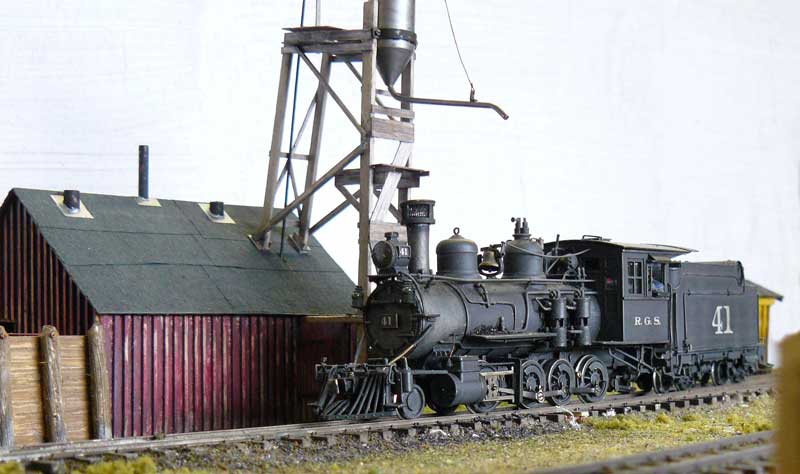
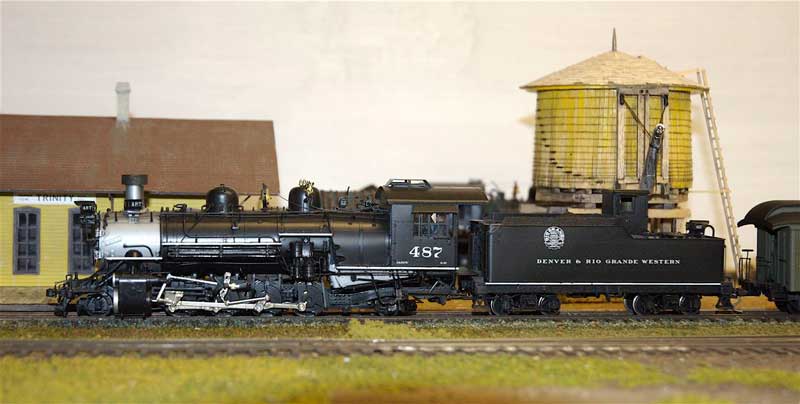
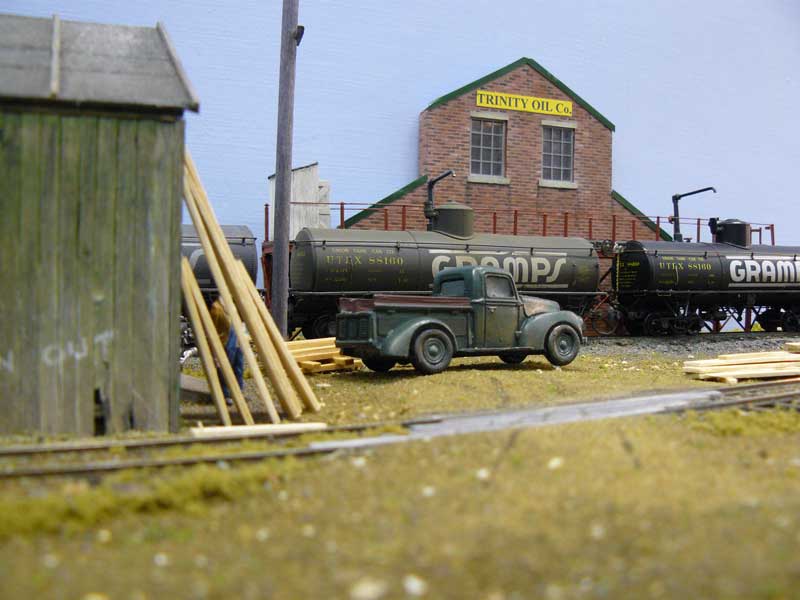
Trinity is the terminus of a branch line that was built, as a joint venture, by the Denver & Rio Grande Railroad and the Colorado & Southern Railway, to tap into the goldfields that were found to the east of the Gunnison area of Colorado in the late 1800s. The time period is 1940 - 1950 and,after years of decline,the town is enjoying a brief respite afternew natural resources have been discovered. The last remaining mine, the Belle Vue, is producing ore that has enough gold and uranium content to make the operation profitable. Also, in recent years, a small oilfield was discovered under the town. The well-head supplies oil through a pipe that is used to load oil tank cars belonging to the Gramps Company of southern Colorado.
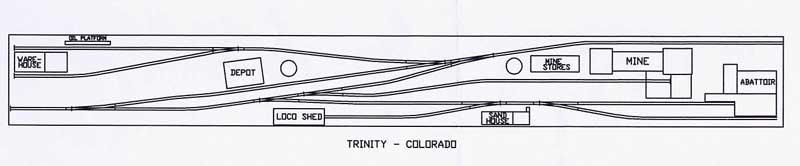
The line is operated by the D&RGW, mainly for freight, but with the occasional passenger or mixed train making an appearance. The railroad maintains a passenger depot and a locomotive shed with its associated facilities. Supplies are brought into the town and to the mine by rail. The main recipient of general goods is the Burrows & Goodrich warehouse. Also, a variety of agricultural products are shipped out from the warehouse.
All of the above is fiction, although the D&RGW and C&S did have lines to the gold and silver mines in the Rocky Mountains. As far as we know, there is no settlement in Colorado that bears the name Trinity. Followers of the game of rugby league may notice that some of the above-mentioned names are familiar.
The layout was built by myself and my son Richard plus John Goodrich and Mike Howden, the latter two being fellow members of the Wakefield Railway Modellers’ Society. Other members of the Society have also made small, but important, contributions.
The track plan is a scaled up and slightly modified version of one that the former Wakefield RMS exhibition manager, Roger Nicholls, used for his Crystal Lake layout. Track-work is from Shinohara and Tomalco and all of the buildings are scratch-built and are based on Colorado prototypes. The majority of the rolling stock is constructed from kits, mainly PBL. All but one of the locomotives is a Japanese or Korean brass product. The odd one out was assembled from a cast pewter kit supplied by Railmaster of New Zealand.
Control of the layout is by MRC DCC units. At the present time only one of the locos is fitted with sound, due to the expense of the sound processors. Hopefully, at some time in the future, they will all have this feature added. The most unusual part of the layout is the method of baseboard construction. The basic board is made from a 4’ x 2’ x 2” thick sheet of blue polyurethane foam that is surrounded by a plywood frame. The result is a very light but rigid board with a surface that can, if necessary, be cut and carved for scenic effects. However, although we have gained an advantage in the weight department we have also come across several disadvantages by using foam. The biggest problem has been that of fastening equipment, e.g. point motors, to the underside of the baseboards. The point motor problem was resolved by cutting a rectangular hole through the foam, in the relevant area, and fixing a piece of plywood into it that had its top surface flush with the top surface of the foam. The motors were attached to aluminium mounting plates that were fixed onto screws projecting down from the pieces of plywood. This allows the whole point motor assembly to be removed from the plywood if necessary. Unfortunately it has been very necessary to carry out this operation on most of the motor assemblies due to problems with them. We have used Hoffman point motors that were recommended by a fellow Wakefield RMS member. We have had a variety of problems with them and several of the plastic components have been replaced by brass equivalents. Our opinion is that these motors are not up to the job that they are supposed to be designed for. Three of them have been replaced by wire in tube manual control and back-up manual control is being installed for all of the other turnouts. This means that if a point motor fails at an exhibition it will not take long to change over to manual control.